Updated
6 min read



Keeping track of payroll is essential for any business, regardless of how big or small the team is. With QuickBooks’ payroll summary report, you can see the clear picture of employee wages, taxes, and employer contributions over a specified period of time. Business owners, accountants, and HR professionals can use this report to stay on top of payroll expenses, ensuring accurate tax filings and compliance with labor laws. The Payroll Summary Report delivers key insights in just a few clicks, regardless of whether you’re looking at total wages, deductions, or net pay.
In this blog, we will walk you through the process of creating a payroll summary report in QuickBooks Online and Desktop, customizing it to meet your needs, and using it to automate your financial planning. Let’s take a look!
QuickBooks’ payroll summary report provides valuable information about employee wages, taxes, deductions, and employer contributions. In addition to ensuring accurate payroll processing, it simplifies tax filings, aids in financial planning, and ensures compliance with labor laws. Easily customizable and easy to generate, this report improves payroll management and overall business efficiency.
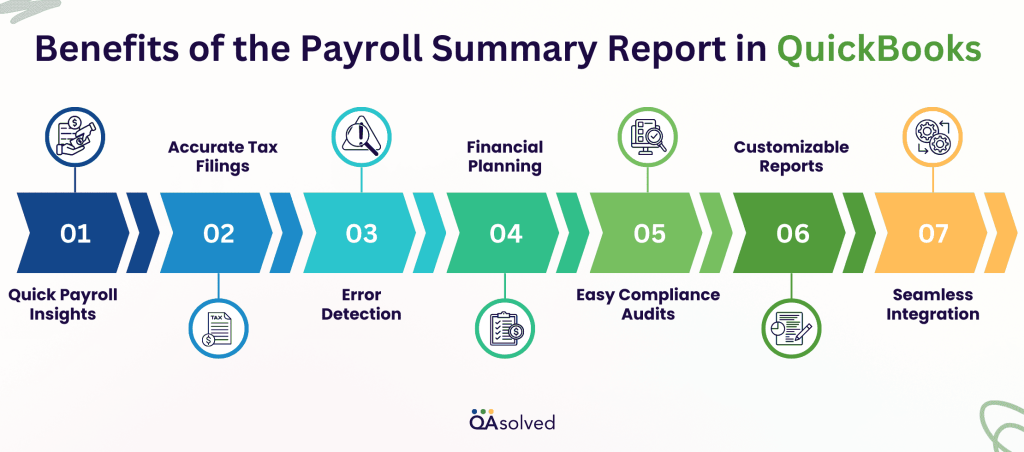
Here are the main benefits of using the Payroll Summary Report in QuickBooks:
The payroll summary report simplifies payroll management and keeps your financial records in top shape. Now, let’s take a look at how you can create a payroll summary report in QuickBooks.
Read More: How to Enter or Edit QuickBooks Payroll Service Key?
Payroll Summary Reports provide a breakdown of total wages, taxes, deductions, and contributions. The report can be generated by following these steps. It is important to note that this report is based on paycheck dates rather than pay period dates.
Create a Payroll Summary Report in QuickBooks Today!
Generate detailed payroll insights in just a few steps and keep your records organized. Need help? Contact us for expert support!
See a breakdown of each employee’s wages, taxes, deductions, and contributions with a Payroll Summary by Employee.
Using these steps, you can generate a Payroll Summary for your employees that contains details specific to them. The report can be customized in order to filter the data by date, employee, and payroll component as needed.
Also Read: Year-End Checklist for QuickBooks Desktop Payroll
Payroll summary reports in QuickBooks are more than just financial records. It is an essential tool for keeping track of wages, taxes, and deductions. This report simplifies payroll management and keeps accurate records, whether you’re verifying payroll data, ensuring tax compliance, or analyzing labor costs. QuickBooks’ intuitive reporting features make generating and editing these reports easy and convenient.
So, maintain your business finances while staying on top of compliance requirements by integrating payroll reporting into your financial workflow. If you get stuck somewhere or if you have any questions, do not hesitate to contact our QuickBooks payroll professionals for expert assistance.
1. Click on Reports
2. In the search box, type the report name, then select it from the suggestions.
3. Choose Customize, then adjust the date range or report options.
4. Create a report and run it.
5. Click on the printer icon.
6. Choose your preferred report orientation, then click Print.
1. Click on Reports.
2. Under ATO Reporting, click Payment Summaries.
3. Select Show Payment Summaries after selecting the appropriate filters.
4. Choose a lodge.
5. Check the terms and conditions, then select Lodge.
6. Then select Close.
1. Select Employees from the top menu bar.
2. Select Payroll Center.
3. Go to the Payroll tab.
4. Select Summarize Payroll Data from the Reports section.
5. Select the report period under Dates.
6. Select the Get QuickBooks Data tab.
7. Select the State Wage Listing worksheet.
8. Go to the Funnel icon and select All.
9. Click OK.
Payroll Register Summaries provide a detailed overview of employee payroll data for a particular period. Wages, taxes, deductions, and employer contributions are included. Businesses can use this report to track payroll expenses, ensure accuracy in payments, and ensure compliance with tax regulations and labor laws.
Payroll Summary reports show total wages, taxes, and deductions for all employees over a period of time. A Pay Stub is an employee’s earnings statement that shows gross pay, deductions, and net pay. Stubs are for employee records, while summaries are used for reporting.
About the author
Have a QuickBooks® question? Our ProAdvisors can help. QAsolved is not affiliated with Intuit.