Updated
7 min read



Managing payroll taxes is indeed one of the most hectic and crucial tasks for a company. With ever-evolving regulations and tight deadlines, staying on top of the payroll taxes has become more important than ever. But what if there was a way to make the entire process smoother and more efficient? Well, that is exactly when QuickBooks comes into the picture.
QuickBooks Desktop’s Federal E-File and E-Pay features make it easy for businesses to manage payroll and taxes. The IRS Form 941, also known as the Employer’s Quarterly Federal Tax, is an important tax form for companies. Businesses must use this form since it reports the income and payroll taxes withheld from employees’ paychecks. Unlike individual taxpayers, businesses must file Form 941 quarterly instead of once a year.
Enhanced Payroll features in QuickBooks Desktop simplify the process of managing payroll. As a result, payroll calculations are done automatically with direct deposits and detailed payroll reports are generated, ensuring accuracy and compliance. The exceptional features also allow you to file Form 941 and make payments from the software electronically.
As we said, the IRS Form 941 stands for Employer’s Quarterly Federal Tax Return. Filing this form ensures that businesses are synched with the tax regulations of the US authorities and allows them to run their operations seamlessly. Today, many growing enterprises have shifted from traditional to advanced bookkeeping and accounting methods. One such solution for them is QuickBooks. Filing such important tax forms with QuickBooks enables businesses with features like accurate financial data, timely submissions, and prevention of hefty penalties.
In this blog, we will highlight the process of setting up the Federal e-file and e-pay for business instructions in QuickBooks Desktop to ensure compliance and efficient payroll tax management.
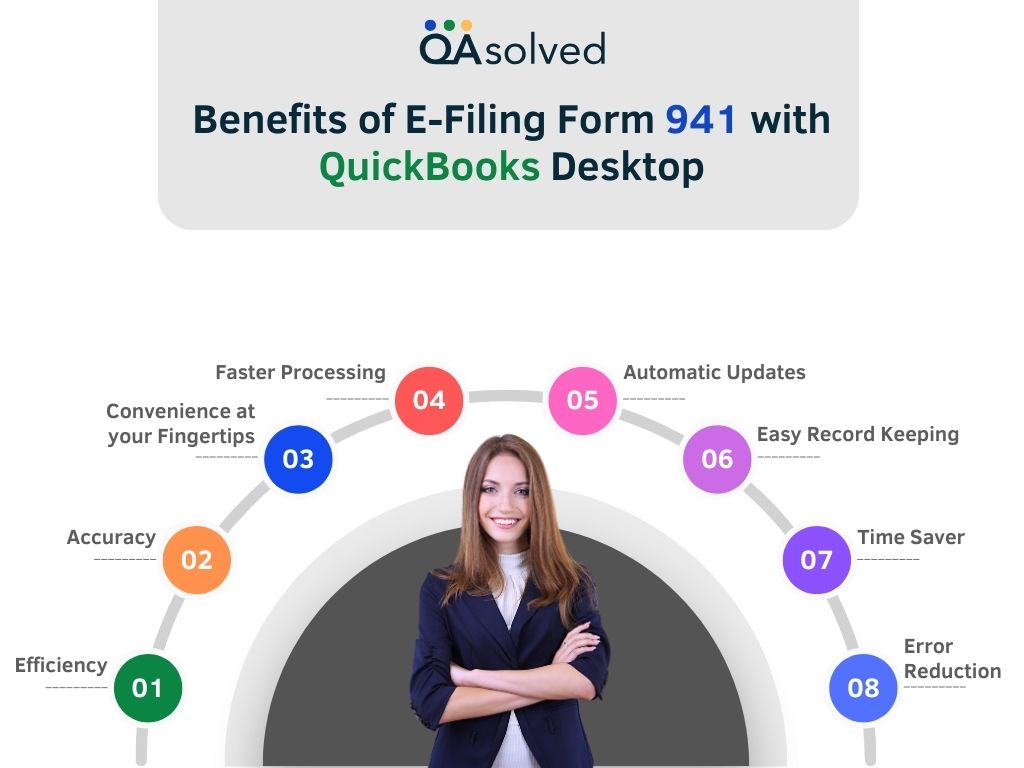
Below are the steps for setting up the e-pay and e-file process in QuickBooks Desktop:
Note: If you don’t have an EFTPS PIN and password, contact the IRS to register.
Enroll if you started your business after 2011
Note: You are required to enroll in EFTPS once. If you’re not sure about your enrollment, then connect with the IRS 1.800.555.4477.
Enrollment for businesses that started before 2011
Your payroll taxes and liabilities have been paid successfully.
If you haven’t signed up for the IRS e-file program, follow the steps below:
Setting upfederal e-file and e-pay for Form 941 in QuickBooks Desktop is a simple process that enhances payroll management efficiency. Following these steps will ensure that you file accurately and make timely payments to the IRS, reducing penalties and interest. With Federal E-File and E-Pay, you can focus more on your business operations while saving time and improving compliance with IRS regulations.
If you’re still facing issues with the same, then QuickBooks experts are here to provide you the best QuickBooks Desktop support service. You can directly reach out at toll-free number: +1-888-245-6075.
1. Launch QuickBooks Desktop Payroll Setup.
2. Select the File Forms tab in the Payroll Center.
3. In the Other Activities section, pick Change Filing Method.
4. Click on Continue.
1. Select the Reports menu.
2. Select Find report by name and search for Payroll Summary.
3. From the drop-down menu, select a date range.
4. Pick an employee or group of employees.
5. Once you’re done, hit Run Report.
It is essential to pay your federal taxes and file the necessary payroll forms on time throughout the year. In QuickBooks Desktop Payroll Enhanced, you can pay and file your 941/944, and 940 taxes and forms electronically.
1. Click on Taxes, then Payroll Tax.
2. Select Quarterly Forms or View and Print Archived Forms to access archives of prior periods’ forms.
3. To access the 941 link.
4. Simply click Preview. Print or download the form in PDF format.
1. Create or modify your federal tax form (941, 944, 943)
2. Pick Payroll Settings under Settings.
3. Choose Edit next to Federal tax.
4. In response to “How often do you pay your taxes?” choose Edit.
5. Choose which form to file, when to pay your taxes, and the effective date of the form.
6. Save your work, then click Done.
About the author
Have a QuickBooks® question? Our ProAdvisors can help. QAsolved is not affiliated with Intuit.