Updated
7 min read


Are you considering using QuickBooks Desktop for Mac? If yes, then kudos to your choice!
For professional and certified accountants, bookkeepers, financial analysts and managers, QuickBooks for Mac has become the ideal solution to manage their clients’ and employers’ finances. QuickBooks Desktop for Mac provides an easy-to-use, robust, and features rich solution for macOS users. Whether you’re a freelancer, small business owner, or professional accountant, this software automates several bookkeeping tasks like tracking expenses, generating invoices, and managing payroll.
Although the interface is user-friendly, it’s important for users to understand the installation and setup processes for QuickBooks Desktop for Mac. This ensures optimal software performance, reduces the risk of potential errors, and allows you to fully leverage QuickBooks features from the start. So, let’s begin!
Ensure your Mac meets the necessary requirements before installing QuickBooks Desktop for Mac. If you run the software on an unsupported system, you may encounter compatibility issues, performance problems, or unexpected errors:
Now that we’ve covered the system requirements, let’s move ahead to understand the installation process. Getting your Mac to meet the necessary specifications is just the first step; now it’s time to download, install, and set up QuickBooks Desktop for Mac.
Set Up QuickBooks Desktop for Mac Today!
Follow our steps for a smooth installation and start managing your finances with ease. Need help? Contact us for expert support!
Now that your Mac meets the system requirements, we’ll walk you through the steps of getting started with QuickBooks. With a smooth installation, you can begin managing your finances immediately. Here we go!
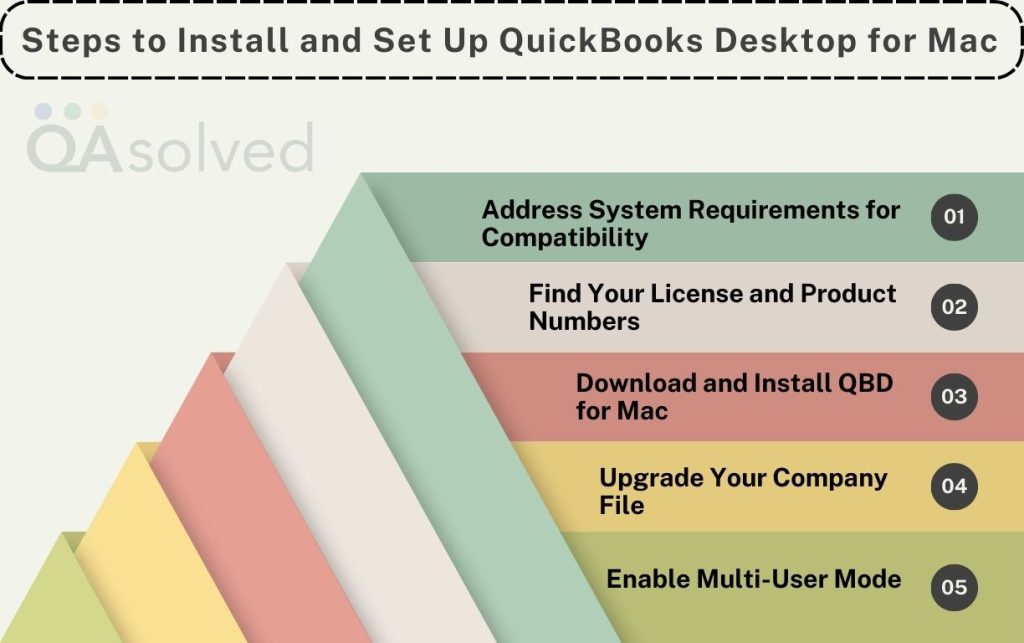
Before installing QuickBooks Desktop for Mac, it’s essential to verify that your system meets the necessary requirements. Ensuring compatibility helps prevent technical issues and ensures smooth performance. Check factors like your macOS version, hardware specifications, and software updates to avoid interruptions.
Refer to the above-mentioned section to meet the compatibility requirements.
Read More: Fix QuickBooks Desktop Installation Errors in Windows and Mac
Are you planning to upgrade from a previous QuickBooks Desktop for Mac version? Then you’ll need to update your company file to ensure compatibility with the newer version.
If multiple users need access to QuickBooks, enable multi-user mode, to allow them to work on the same company file simultaneously from different workstations.
So, these are the 5 steps to successfully install QuickBooks Desktop for Mac. If you encounter any issues during installation or while using QBD for Mac, our certified ProAdvisors are ready to assist you every step of the way. Call us at +1-888-245-6075 to unlock the full potential of QuickBooks for your day-to-day accounting operations.
Also Read: How to Setup Multi-User Mode in QuickBooks Desktop for Mac?
Setting up and installing QuickBooks Desktop for Mac are key steps to streamlining your business finances. Ensure a smooth, efficient accounting experience by checking system requirements, downloading the software properly, and carefully following the installation steps outlined above. After installing QuickBooks, you can configure it to meet your business needs, such as setting up your company file, enabling multi-user mode, and customizing preferences.
In case you’re facing any trouble with QuickBooks Desktop for Mac, don’t worry—we’re here to help! Contact our QuickBooks Mac support team for personalized assistance, so you can get back to managing your finances without any interruptions.
Currently, QuickBooks Desktop for Mac 2024 is available, but older versions have been discontinued. Stay up to date with Intuit’s announcements, since future versions may be phased out. We recommend QuickBooks Online for long-term Mac compatibility and cloud-based access.
Yes, the features and interface of QuickBooks Desktop for Mac are different from those of the Windows version. The Mac version is tailored for macOS, but it does not include some advanced features such as batch invoicing, industry-specific editions, and advanced reporting. Nonetheless, it is compatible with Apple applications and offers an experience akin to that of a Mac.
1. Access the app on your Mac.
2. Choose QuickBooks from the upper menu, and then select Register QuickBooks.
3. Enter your product and license number (these can be found in your email confirmation or on the retail package).
4. Use your Intuit account to sign in by following the prompts on the screen.
5. Once your registration is verified, QuickBooks confirms it and you’re all ready to go!
Yes, it is possible to transfer QuickBooks Desktop from Windows to Mac, but you will need to convert the files because the two versions use different formats. Here’s the way:
On QuickBooks Windows:
1. Access your company file.
2. Navigate to File > Utilities > Copy Company File for QuickBooks Mac.
3. Save the file using the .qbb extension (backup format).
On QuickBooks Mac:
1. Launch QuickBooks and navigate to File > Restore.
2. Select the .qbb file and follow the prompts to convert it.
1. Access QuickBooks and select the QuickBooks▼ menu.
2. Choose Check for QuickBooks Updates.
3. If an update is available, hit Install Update.
4. When prompted, choose Install and Relaunch.
5. Once the update is complete, QuickBooks will reopen automatically.
About the author
Have a QuickBooks® question? Our ProAdvisors can help. QAsolved is not affiliated with Intuit.