Updated
6 min read



Running payroll accurately matters for every business. With QuickBooks® Desktop Payroll you can create and print paychecks or pay employees by direct deposit, whichever payroll service level you subscribe to.
This article will walk you through the step-by-step process of generating paychecks for your employees, ensuring accuracy and saving you time. Let’s get started and learn how to create paychecks using QuickBooks Desktop Payroll.
Note: These steps will be relevant as long as you have basic enhanced or assisted payroll and these steps work for creating and printing paychecks or for using its direct deposit service.
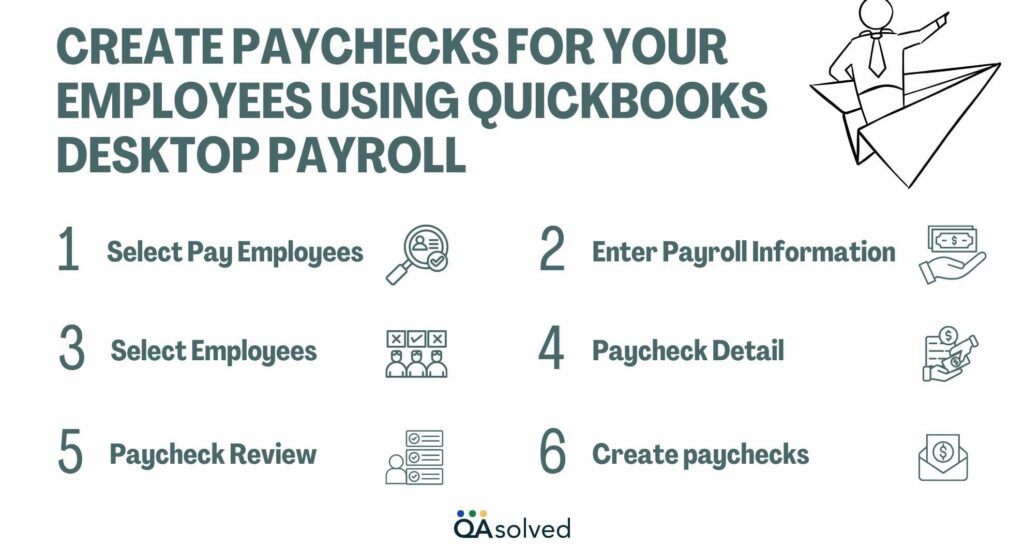
If you’re utilizing Intuit’s direct deposit service or QuickBooks desktop payroll assistance, you’ll receive a prompt to send payroll data to Intuit.
Need Help Creating Paychecks in QuickBooks® Desktop?
Payroll can be tricky. Our team at QAsolved can walk you through each step, so call us or start a live chat.
By following these straightforward steps, you can efficiently create and manage paychecks for your employees using QuickBooks Desktop Payroll. Whether you are running a scheduled payroll or handling an unscheduled one, QuickBooks simplifies the process, ensuring that all necessary details are accurately recorded and reviewed.
If you would rather hand payroll off altogether, our team at QAsolved also offers payroll management services.
If you get stuck at any step, contact our team at QAsolved or call us at +1-888-245-6075.
If an outside payroll service pays your employees, you can still keep your books up to date by recording each payroll run as a journal entry.
1. Get the payroll report or pay stubs for the pay period from your payroll provider.
2. In QuickBooks® Desktop, open the Company menu and choose Make General Journal Entries.
3. Use the check date as the entry date. You can put the payroll run or check number in the entry number field.
4. Debit gross wages and employer taxes to your payroll expense accounts, credit the withholdings and employer taxes to your payroll liability accounts, and credit the net pay to the bank account the wages came from.
5. Save the entry. Use one entry per payroll run, or one per employee if you want more detail.
QuickBooks® Desktop keeps a pay stub for every paycheck you create, so first run payroll as shown above. Then:
1. Open the File menu, choose Print Forms, then Pay Stubs.
2. Pick the bank account the paychecks were written from and the date range you need.
3. Select the employees whose stubs you want.
4. Choose Preview to check them, then Print, or Email if you send stubs to employees electronically.
If a paycheck was deleted or voided by mistake and the employee still needs to be paid, run an unscheduled payroll for that employee:
1. Open the Employees menu, choose Pay Employees, then Unscheduled Payroll.
2. Enter the same pay period and check date as the original paycheck.
3. Select the employee and open the paycheck detail.
4. Enter the same pay items, rates and hours as the original, and check that the net pay matches.
5. Save, continue to the review screen and create the paycheck.
If the original was a direct deposit the employee already received, do not pay it again. Talk to your accountant or our team about recording it without sending a second payment.
To pay an employee again in the same pay period, for example for a bonus or missed hours, run an unscheduled payroll:
1. Open the Employees menu, choose Pay Employees, then Unscheduled Payroll.
2. Enter the pay period and check date, and select the employee.
3. Open the paycheck detail and enter only the extra pay.
4. If QuickBooks® warns that the employee already has a paycheck for this period, confirm that you want to create another one.
5. Review the amounts and create the paycheck.
About the author
Have a QuickBooks® question? Our ProAdvisors can help. QAsolved is not affiliated with Intuit.